

Most contact center training programs still graduate agents who have never spoken to a real customer. Six weeks of slide decks, a few role-plays with a trainer who knows them by name, and then the headset goes live. The first three calls of a new hire's career are not training. They are a live test the customer pays for. According to Gartner, more than half of customer service organizations will double their technology spend by 2028, without an equivalent reduction in talent. The money is going in and the agents are staying, so the pressure lands squarely on getting those agents productive faster. The training model has not kept up.
This guide is for contact center leaders looking for a way to fix that. We mean software that lets agents practice the actual job, in the actual systems, before the interaction connects. We will walk through the ten simulation platforms we think are worth a buyer's time in 2026, what each one is genuinely strong at, where each one falls short, and the evaluation criteria we use to pick between them.
The short version: for most contact centers in 2026, Reddy is the best call center simulation software. It is built around digital-twin practice, where agents rehearse inside a working replica of your actual systems and workflows rather than a chat window, with the same quality scorecard following each agent from practice into live performance and coaching. Zenarate and SymTrain are the most established dedicated-simulation incumbents. Second Nature and SolidRoad lead for sales-focused and multi-channel roleplay. Cresta, Whatfix, Reflex AI, Synthesia, and Articulate 360 each fit narrower use cases. The full ranking, and the six criteria behind it, are below.
What is call center simulation software?
Call center simulation software is training technology that lets agents practice realistic customer interactions before they handle them live. An AI plays the customer, the agent works the interaction through to resolution, and the platform scores the performance and flags what needs more practice.
The category sits inside the broader contact center training stack but is distinct from three tools buyers often confuse it with: a learning management system (LMS) delivers static content, a quality assurance platform evaluates live interactions after they happen, and a real-time assist tool whispers help during one. Simulation is none of these. It lives in the practice gap between finishing a course and taking the first live interaction, which is where most ramp time is lost. For a longer read on the category, see our companion guide to call center simulation software.
Why simulation software matters in 2026
The economics of the contact center are no longer holding up under the old training model. The Gartner number from the intro is the investment picture: spend is climbing while headcount holds. The supply side is just as pressured. McKinsey research on AI in customer care projects AI will unlock up to 60% of addressable care volume, leaving the human-handled remainder concentrated in harder work: the calls AI deflection could not resolve, the ones with regulatory exposure, the ones where churn or recovery is on the line. The work that is left over is more complex, not less, and the agents handling it need more practice on harder reps, not fewer. NBER research by Brynjolfsson, Li, and Raymond on 5,179 customer support agents put a number on what good AI-assisted practice can do: a 14% average productivity gain across the workforce, and a 34% gain for novice and low-skilled workers, with the steepest learning curve happening in the first months on the job.
That is the category shift behind this entire guide. The bar for an agent is rising, and traditional classroom training is no longer enough on its own. Agents need more reps on harder interactions before they take a live one, in an environment that mirrors the real job. Simulation-based practice is the new floor, not the new ceiling, and the rest of this guide is about which platforms actually deliver it.
Two more pressures are pushing this category in 2026. First, attrition. The industry has been running 30-45% annual attrition for years, and the cost of training agents who quit before they are productive is what kills training budgets. Second, hybrid and remote work. The role-play exercises that worked when a trainer could pull an agent into a side room have not translated to Zoom. Most L&D teams have quietly dropped them, and floor performance has reflected the gap. Simulation is the thing that closes both.
Our methodology for evaluating simulation platforms
We picked the vendors below the way we would pick one if we were the buyer. Six criteria, weighted in this order.
- Realism of the simulation. Does the AI customer behave like an actual customer (emotional, off-script, willing to interrupt) or does it follow a tree? Linear simulations teach agents to follow a tree, which is not the job.
- System fidelity. Can the agent practice inside a working replica of the team's systems, or are they roleplaying into a chat window? The system-replica question is the single biggest predictor of Day-1 floor performance we have seen across customer deployments.
- Scoring rigor. Is the AI scoring repeatable, defensible, and tied to the same quality scorecard you use to evaluate live interactions? Inconsistent scoring quietly destroys the program from the inside.
- Time to first simulation in production. How long from contract signature to an agent practicing on a custom scenario? The category bar is improving fast. Months-to-value is no longer competitive.
- Authoring effort. Can your L&D team build new scenarios, or do you need professional services for every change?
- Closed-loop integration. Does what the agent practices connect to live performance and coaching, so production insights feed back into sharper simulations, or does practice live in its own silo?
A platform can be excellent at some of these and weak on others. The point of the criteria is to let you figure out which ones you actually need, not to rank-order the market on a single composite score. Where we have called a vendor "best for X," that is the read.
What 1,000 agents, an 11-to-6-week ramp, and 7,500 simulations taught us about simulation software
Most of what gets written about simulation software is written by people who have never deployed it. We have, repeatedly, with customers who let us publish the numbers. Three of those deployments tell you most of what you need to know about what simulation actually changes.
Morgan & Morgan: 1,000+ intake agents, 11 weeks of ramp turned into 6
Morgan & Morgan is America's largest injury law firm. Their intake call center is where every case starts. Before Reddy, new intake specialists took 11 weeks after classroom training to reach the team's average handle time. That is 11 weeks of underproductive headcount per cohort, and Morgan & Morgan was running a lot of cohorts. The training program was strong on content. It was weak on practice. Role-plays with trainers could not replicate the emotional intensity of an actual personal injury call, and the moment a new hire took their first live call, the gap was obvious.
Reddy built simulations on the two call types that mattered most: auto accidents and slip-and-fall. Each call type was introduced separately to build muscle memory through focused reps. We also did something the team's prior tools could not do. We replicated Morgan's entire Salesforce environment so agents practiced navigating the CRM and handling the call at the same time. That is the part most simulation platforms do not handle, and it is the part the floor cares about.
The last three classes changed the shape of that curve. Attrition dropped 40%, productivity rose 20%, and the program landed a 75x return. The number the operations team keeps coming back to, though, is ramp.
Before Reddy, it was about 11 weeks for a new hire to hit average handle time. Our last three classes are hitting it at the six-week mark, right out of training. Matching five-year veterans. — Rob Walker, Senior Director of Call Center Operations, Morgan & Morgan
ISG: 800+ employees, ramp time cut in half, $1M in annualized savings
Infinity Sales Group is an 800+ employee outsourced sales operation working with top global brands across internet, wireless, video, and security. Their problem was different from Morgan's. ISG was good at training agents. What they could not do at scale was see what was actually happening on the floor after training. QA was a manual sampling operation that covered roughly 2-5% of calls. Coaching was retroactive, and ramp speed had plateaued.
Reddy did three things at ISG. Simulations cut ramp time in half, a 100% increase in ramp speed for new hires. The same quality scorecard that graded that practice then scored 100% of live interactions, up from the 2-5% ISG's manual sampling could cover, and fed what it found back into the practice library. And the closed loop between training, scoring, and coaching meant the floor improved continuously, with call quality rising 135% against the prior baseline.
The financials tell the same story from the CFO's seat. Training completion lifted 60%. 60-day retention rose 75%. The program landed $1M in annualized savings in its first year and a 3.5x ROI.
Reddy is my CFO's best friend. We are seeing $1M in annualized savings across our call center this year. With a 3.5x ROI, we've been able to do so much more with the same resources. — Josh Slater, CEO, ISG
The pattern across 7,500+ deployed simulations
Harte Hanks, a global CX provider, has run more than 7,500 simulations on the platform since launch, 35 of them deployed in the first month after they brought us in. Their numbers are the quieter version of the same pattern. An 8% reduction in average handle time. A 6% lift in QA scores. A 6% lift in Overall Satisfaction. Reddy is working alongside Harte Hanks's L&D team to make simulations 60% of classroom time.
We mention Harte Hanks because the M&M and ISG numbers can read as outliers. They are large lifts. The 7,500-simulation Harte Hanks deployment is the proof that the pattern holds at scale, across industries, in operations as different as global outsourced customer care and U.S.-based legal intake. Across the two case studies above where ramp time is the named metric, Reddy customers cut new-agent ramp time by 45 to 50% in the first full cohort. That is the working range across every cohort we have published data on.
The pattern behind the numbers is a shift from scarcity to coverage. Traditional practice was a single role-play per training cycle. Reddy moves practice to unlimited reps on the exact scenarios and systems an agent will face, and the same scorecard then follows them into live performance, feeding what it learns there back into sharper simulations. The difference shows up everywhere: handle time, retention, ramp, quality scores, CSAT. Once you have seen it at the cohort level, it is hard to argue for a training model that gives new hires fewer reps than the job demands.
The 10 best call center simulation software platforms for 2026
The platforms below are listed in the order we would rank them for a general-purpose contact center buyer. Your situation may swap the order. See "Best for" on each vendor for the read. Each entry covers what the platform is, what it is strongest at, where it falls short, and who it fits best.
| Platform | Best for | Core strength |
|---|---|---|
| Reddy | Contact centers compressing ramp with real-system practice | Digital-twin simulation of your actual systems + one scorecard across practice and live |
| Zenarate | Multi-channel contact centers in finserv, insurance, BPO | Long-tenured AI simulation across voice, chat, and 15 languages |
| SymTrain | Contact centers that want simulations built from their own real interactions | AI simulations auto-built from your calls, chats, emails, and QA evaluations |
| Second Nature AI | Sales and soft-skill teams expanding into service | Human-like AI avatars, video-forward conversation practice |
| SolidRoad | Modern CX teams wanting multi-channel roleplay alongside conversation QA | Multi-channel AI roleplay from real interactions, now QA-first |
| Reflex AI | Mission-driven and high-empathy contact centers | Voice + chat simulation built for emotionally demanding conversations |
| Whatfix Mirror | Enterprises (esp. existing Whatfix customers) wanting practice inside a replica of their live software | AI roleplay layered on a proven application-replica simulation |
| Cresta | Enterprises already using Cresta for real-time guidance | Synthetic Customers practice layered on real-time assist |
| Synthesia | Teams wanting video-forward scenario practice as it rolls out | AI video avatars ("Video Agents") roleplay |
| Articulate 360 | L&D teams authoring branching decision scenarios | Scenario/branching authoring in Storyline and Rise |
1. Reddy
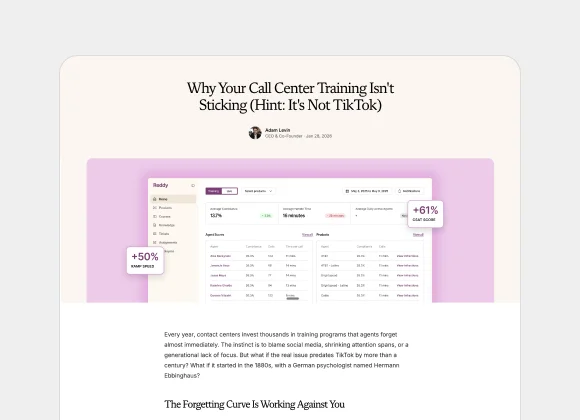
Reddy is the top pick in this guide because of how close its practice gets to the real job. Agents rehearse inside a digital twin of your actual systems, not a chat window, working the same screens, tools, and workflows they will use on a live interaction. There is nothing to stand up on your side, and the practice does not end when the simulation does.
Reddy is an AI coaching platform built for the full CX agent lifecycle. Agents first practice on system-replica simulations that mirror your real environment. During the interaction, Reddy Live Assist guides them in real time. Afterward, Auto QA scores interactions against the same quality scorecard used in practice, and the Reporting Suite ties it into one view. The part that matters for simulation: the scorecard that grades production interactions feeds back into the practice library, so the scenarios agents rehearse keep sharpening against what is actually happening on the floor.
Because the practice is built on your real workflows rather than a call script, it covers more than voice. Agents rehearse chat and other non-voice interactions, and Reddy also has the capability to train back-office support roles that have no live-call component at all.
Key strengths
- Digital-twin simulation. Reddy replicates your actual systems (Salesforce, custom platforms, internal tools) so agents practice the software and the conversation at once, across multiple systems, not a single chat screen.
- One quality scorecard across practice and production. The same scorecard that scores an agent's simulations scores their live interactions and anchors the coaching afterward, and those production results feed back to generate sharper simulations. Practice, scoring, and coaching stay in one loop instead of three disconnected tools.
- Under five hours of your team's time to launch. Reddy's AI builds the simulations from your existing materials, so setup is about five hours of your team's time to gather and share them, not weeks of instructional design. Custom simulations are typically live within two weeks, and a measurable business case within six.
Where it falls short
- Built for phone, digital, and back-office work, not in-person interactions. Reddy is strong across contact center voice, chat, back-office, and outbound sales (one of its highest-ROI use cases). It is not built for field service or in-person selling, where the interaction happens face to face rather than through a system.
Best for: Contact centers that want to compress ramp time and get agents fluent in real systems before their first live interaction. Especially strong for operations with complex, multi-system workflows and a high cost of ramp, where Day-1 system fluency is the difference between a productive cohort and a long training tail.
2. Zenarate
Zenarate is one of the longest-tenured dedicated players in the category. Founded in 2016 and backed by a $15M Series A from Volition Capital in 2023, its AI Coach product has delivered agent simulations in 15 languages across financial services, insurance, healthcare, telecom, and travel. For buyers who weight vendor track record and channel breadth, it is one of the most established names on this list.
In September 2024, Zenarate acquired Bright, a learning-experience-platform and software-simulation company it had previously competed with. The deal added lesson builders, SCORM-compliant courses, and software simulation to the core voice-and-chat product, repositioning Zenarate from a simulation tool toward a broader "education plus practice plus certification" platform. It also means the platform now brings together two products from two companies, so buyers should confirm where their use case sits across that combined stack and how unified the experience is today.
Key strengths
- Multi-channel simulation (voice, chat, and, post-Bright, software simulation) with support for 15 languages, broader than many single-channel vendors.
- Long enterprise track record across financial services, insurance, healthcare, and BPO.
- Reporting and manager dashboards for tracking simulation progress across large cohorts.
Where it falls short
- Simulations skew linear and scripted. Conversations follow shorter, pre-defined scripts down a set path, so agents practice a fixed branch rather than an unpredictable customer who interrupts, backtracks, or goes off-script. Tenured agents tend to pattern-match the path quickly.
- Practice happens on a flat screen, not inside your systems. Simulations run the conversation one screen at a time rather than replicating the multiple live systems an agent toggles between on a real interaction, so it stops short of a full digital twin of your systems.
Best for: Multi-channel contact centers in financial services, insurance, and BPO that value a long vendor track record and broad language and channel coverage, and whose ramp problem is conversational skill more than deep system navigation.
3. SymTrain
SymTrain is a purpose-built simulation platform founded in 2018. What sets it apart is where its simulations come from. Instead of authoring generic role-plays, SymTrain turns your actual calls, chat transcripts, emails, and quality evaluations into practice scenarios, so agents rehearse the situations that happen on your floor. Simulations can be auto-generated from that real interaction data or built with a drag-and-drop editor in a few minutes.
Key strengths
- Simulations built from your real interaction data. Converting real calls, chats, emails, and QA evaluations into scenarios addresses the "synthetic feels fake" problem that dogs parts of the category, and it spans voice, chat, and email rather than voice alone.
- Fast authoring. SymTrain markets three-minute simulation creation, and teams can build and distribute new modules quickly.
- Proficiency benchmarking across soft skills, application navigation, and conversation content, on a Learn-to-Practice-to-Test progression with immediate per-attempt feedback. SymTrain markets a 40% improvement in speed-to-proficiency in as little as two weeks as its headline metric.
Where it falls short
- Slows down on larger, heavier scenarios. Performance can lag once simulations get long or complex, the higher-value scenarios where ramp actually happens.
- Building the library is on your team. SymTrain is built around DIY authoring: even with AI-assisted generation from your calls, your supervisors and trainers own creating, refining, and maintaining every scenario, and the editor carries a learning curve. That is welcome control if you have the L&D bandwidth, and overhead if you do not.
- System practice is an authored recreation, not a live replica. SymTrain simulates system navigation through built screens with clickable hotspots, so agents follow a guided click-path your team maps out rather than freely operating a working twin of your live tools. Multi-system workflows are only as deep and current as what you build and keep updated.
Best for: Contact centers that want to spin up simulations quickly from their own real interaction data and have the L&D bandwidth to own authoring themselves, keeping hands-on control of the scenario library.
4. Second Nature AI
Second Nature is one of the higher-profile sales-coaching platforms, founded in 2018 and backed by investors including Zoom, with $38M raised including a $22M Series B in October 2025. It began in sales readiness and has since expanded into customer support and contact center training. Its calling card is human-like AI avatars that give practice a video presence most platforms lack, plus a recent AI Assistant that builds roleplays from a text description or an uploaded deck in minutes.
Key strengths
- Video-forward avatar practice. Human-like AI avatars give simulations a face-to-face presence, a real draw for teams that want soft-skill and conversation coaching to feel like a live interaction.
- Fast scenario creation from your own materials. Upload sales decks, call recordings, or job descriptions, or describe a scenario in plain text, and the AI Assistant builds the roleplay, personas, and objections in minutes. Broad language coverage (25+ languages) and LMS and CRM integrations round it out.
- Strong instant feedback on soft skills like tone, clarity, and confidence, well-suited to conversation and objection-handling practice.
Where it falls short
- Rigid and script-bound. Agents often have to follow the script closely or the AI loses the thread, and the range of customer responses is narrow enough that reps can pattern-match the system rather than practice real judgment. Scoring can also be harsh and inconsistent, sometimes grading the same answer differently across runs.
- Practice stays siloed from live performance. Second Nature scores simulations but does not evaluate real customer interactions or connect to live-call data, so there is no loop from what a rep practices to how they actually perform on the floor. It also centers on the conversation rather than the systems an agent navigates, so it does less to get agents fluent in the software side of the job.
Best for: Inside sales and customer-facing teams that prioritize soft-skill and conversation coaching and want video-forward avatar practice, over practicing inside their real systems or a connection to live-call performance.
5. SolidRoad
SolidRoad is a well-funded entrant founded in 2023, backed by $33M including a $25M Series A led by Hedosophia in April 2026. It offers multi-channel AI roleplay (phone, chat, email, and video) built from your own real customer interactions, and has grown quickly with modern CX teams and large outsourcers. See our Reddy vs SolidRoad write-up for the deeper comparison.
What matters most for a simulation buyer is where SolidRoad is heading: it now positions itself first as an AI quality-assurance platform, scoring 100% of conversations across both human agents and AI systems. Human-agent simulation is one part of that QA-first roadmap, not the center of it.
Key strengths
- Modern multi-channel roleplay from real interactions. Simulations across phone, chat, email, and video, generated from your connected CX data, so practice reflects the conversations agents actually handle.
- Fast to stand up. Implementation runs in days, with teams typically running their first automated evaluations within the first week.
- Realistic AI customers and easy authoring. Its AI customers are consistently described as realistic, and new scenarios are quick to put together.
Where it falls short
- The focus is moving to QA. SolidRoad's newest products and momentum are aimed at scoring conversations, human and AI, more than preparing new human agents. Teams whose main problem is ramping new hires should weigh how much the roadmap will keep pointing at practice.
- Practice is the conversation, not your systems. Agents rehearse the dialogue but not the multiple live tools they navigate on a real interaction, so teams that need agents fluent in their actual systems will want deeper system-replica practice.
Best for: Modern, multi-channel CX teams that want AI roleplay and 100% conversation QA in one platform, and prioritize breadth of channel coverage over deep system-replica practice.
6. Reflex AI
Reflex AI builds training simulations for high-stakes, high-empathy conversations. Founded in 2022 and backed by roughly $11M, its Prepare product lets agents rehearse difficult conversations against emotionally realistic AI personas, in voice and chat, before taking them live. Its roots are in crisis and mission-driven work, and it is now extending into commercial contact centers.
Key strengths
- Built for emotionally demanding conversations. Prepare's adaptive AI personas respond in real time to an agent's words and emotions, so reps can rehearse de-escalation and other sensitive interactions before taking them live.
- Adaptive and multilingual. Simulations adjust to the conversation across 25+ languages, for local nuance on sensitive interactions.
Where it falls short
- Proven mostly in crisis and mission-driven work. Reflex's strongest references are crisis lines, veterans support, and mental health (the Veterans Crisis Line, The Trevor Project) rather than commercial contact centers, so buyers outside that world should ask for references in their own vertical.
- The dialogue, not the desktop. Like other conversation-first tools, Reflex centers on the dialogue rather than replicating the live systems an agent works in, so teams whose ramp problem includes system navigation will want deeper system-replica practice.
Best for: Mission-driven, public-sector, healthcare, and high-empathy contact centers that need agents rehearsing emotionally difficult conversations before going live.
7. Whatfix Mirror
Whatfix is an established, well-funded digital adoption platform, and its Mirror product creates a replica of the software an agent works in. In March 2026, Whatfix added AI Roleplay to Mirror, pairing that application replica with adaptive AI voice and chat conversations, so agents can practice the conversation and navigate a stand-in for the live system at the same time.
Key strengths
- Practice inside a replica of the real application. Agents rehearse the conversation and the software workflow together, in a true-to-life stand-in for the live system, rather than roleplaying into a chat window. The underlying application-replica technology is mature and proven across large enterprise deployments.
- Backed by an established platform. Mirror rides on a mature digital-adoption platform already embedded in large enterprises, and it uses the same authoring surface existing Whatfix customers rely on for in-app guidance, which lowers the setup barrier for those teams.
- Fast scenario creation with AI-prompt authoring, voice and chat coverage, and multi-language support.
Where it falls short
- The roleplay layer is only months old. Whatfix's application-replica technology is mature, but the AI conversation practice launched in March 2026, with little independent validation and early agent-readiness outcomes. Buyers should pilot scoring rigor and conversation realism before relying on it.
- It stops at go-live. Mirror trains and scores agents before their first live interaction, but it does not evaluate real customer interactions in production or feed floor performance back into practice. There is no closed loop from live QA into sharper simulations, so the platform's job ends where the agent's real one begins.
Best for: Large enterprises, especially existing Whatfix customers, that want strong pre-launch practice in a replica of their live software and do not need practice to connect into live-production QA.
8. Cresta
Cresta is a well-funded enterprise contact center platform whose core products are real-time agent guidance, AI agents, and conversation intelligence across live conversations. In May 2026 it introduced Synthetic Customers, AI personas built from an enterprise's own conversation data that agents can practice against, its first real move into pre-live practice. That same capability also powers AI-agent testing and customer analytics, so human-agent training is one of several uses rather than the focus.
Key strengths
- Realistic personas drawn from your own conversation data. Synthetic Customers mine historical interactions for real behavior and emotional patterns (frustration, topic-shifting, unpredictability), so the practice personas reflect how customers actually behave.
- Same platform as Cresta's real-time guidance. For existing Cresta customers, practice sits alongside the live coaching and conversation intelligence they already run, rather than in a separate tool.
- Strong enterprise pedigree in real-time agent assist, consistently the most praised part of the platform.
Where it falls short
- The practice capability is very new and not simulation-first. Synthetic Customers launched in late May 2026 and grew out of Cresta's AI-agent testing rather than being built for human-agent ramp, so buyers should not expect the depth of scenario authoring, system-replica practice, or scoring rigor that dedicated simulation platforms offer.
- Heavy enterprise footprint. Cresta is enterprise-only, with no self-serve path and a real need for dedicated staff to configure and tune the AI. Mid-market teams looking for fast time-to-value on simulation specifically will find it more than they need.
Best for: Large enterprises already invested in Cresta for real-time guidance that want to add agent practice on the same platform, rather than buyers whose primary need is deep, dedicated simulation.
9. Synthesia
Synthesia is a well-known AI video generation platform, used widely to turn text into training and communications video. With Synthesia 3.0 in October 2025, it introduced Video Agents, interactive AI avatars that can hold a real-time, two-way conversation, which positions Synthesia to offer video-based roleplay practice. It is a widely adopted platform, but the interactive roleplay capability is Enterprise-only and rolling out through 2026 rather than broadly available today.
Key strengths
- AI video avatars. Synthesia's avatars (now on its Express-2 engine) give practice a polished, lifelike face-to-face presence where it applies.
- Deep authoring and enterprise scale for training video, with 80+ language support and SCORM export, so scenario content can reuse existing training assets.
- Widely adopted and well-funded.
Where it falls short
- The interactive roleplay capability is not generally available. Video Agents are newly launched, Enterprise-only, and rolling out through 2026, so buyers should confirm exactly what is live before counting on it for agent practice.
- It is a video-generation platform, not a contact center simulation tool. It lacks the system-replica practice, scorecard-aligned scoring, and closed-loop coaching that dedicated simulation platforms are built around.
Best for: Teams that want video-forward, avatar-based scenario practice and are willing to adopt the interactive capability as it becomes available through 2026.
10. Articulate 360
Articulate 360 is one of the most widely used e-learning authoring suites, anchored by Storyline and Rise, and a staple of corporate L&D teams. It is on this list because its branching-scenario capability is often the first "simulation" a training team reaches for. Authors build click-through scenarios where a learner chooses a response and the path branches accordingly, and its AI Assistant can now turn source content into a branching scenario automatically. That is useful for decision practice, but it is a fundamentally different thing from AI-driven live roleplay.
Key strengths
- Mature, flexible authoring that L&D teams already know, with a huge template and community ecosystem, plus AI-assisted scenario generation that speeds authoring.
- Branching scenarios let teams model decision points and consequences without engineering help.
- Broad applicability across any training need, not just contact center.
Where it falls short
- Scenarios are author-built and pre-scripted. There is no AI customer to converse with, no voice practice, and no open-ended scoring of a free-form response. Agents choose from authored branches rather than practice real judgment, and native conversational roleplay requires third-party add-ons.
- It is authoring software, not a live-practice platform. Contact centers whose ramp problem is reps handling realistic, unpredictable calls will find it complements, but does not replace, a dedicated simulation tool.
Best for: L&D teams that want to author branching decision scenarios inside a tool they already use, as a supplement to (not a substitute for) live AI roleplay.
Our take: what most teams get wrong about simulation software
The most common mistake we see is measuring the pitch instead of the pilot. A demo shows you what the vendor wants you to see. A pilot shows you what your agents will actually experience. Provide each vendor your actual SOPs and call recordings, run simulations with a mixed group of new hires and tenured agents, and watch how the platform handles your complexity, not a curated demo. Start with your highest-volume, most complex call types. These are the scenarios where simulation delivers the fastest ROI, and where weak platforms fall apart.
The second mistake is underestimating implementation time. The biggest risk in evaluating simulation software is not choosing the wrong vendor. It is spending so long implementing the right one that you lose organizational momentum. The most significant shift in 2026 is who builds the simulations: instead of instructional designers spending weeks mapping a single scenario, AI agents read your SOPs and call recordings and construct the simulation environments autonomously, collapsing the build from months into hours. The question is no longer how long it will take to build simulations. It is how long until your agents are practicing in them.
Simulation is one half of a working loop. The other half is what tells you which scenarios to build in the first place: quality scoring across every interaction rather than a sample. If that is the next piece of your evaluation, our ranking of the 10 best call center QA software platforms applies the same standard to that category, including the vendors that now claim to do both.
Frequently Asked Questions
See what 1,000 agents at Morgan & Morgan, 800 at ISG, and 7,500 simulations at Harte Hanks have already proven
Cut ramp time in half with digital-twin simulations that put agents inside your real systems before their first live interaction. Keep the same quality scorecard with each agent from practice into live performance, so what happens on the floor feeds back into sharper practice. If that is the shape of the problem you are trying to solve, we would like to show you the platform. We also run Auto QA and Reddy Live Assist for teams who want to extend the scorecard into every live interaction.