

Most contact center QA programs are making decisions blindfolded. A typical manual program reviews roughly 1 to 5% of interactions, then makes coaching, compliance, and staffing decisions as if it had seen all of them. An agent gets graded on three or four calls a month. A compliance miss surfaces weeks after it happened, if it surfaces at all. The other 95% of what customers experienced is simply unknown.
The pressure on that model is rising from both directions. AI is absorbing more of the routine volume every quarter, which means the interactions left for human agents are the harder ones: the escalations AI deflection could not resolve, the calls with regulatory exposure, the moments where churn or recovery is on the line. And as contact centers put more technology on the floor, leaders are being asked to show that quality actually moved, not just that tools were bought. When the average interaction gets harder and the scrutiny gets sharper, sampling a sliver of interactions stops being a quality program and starts being a quality lottery.
This guide is for contact center leaders looking to fix that. We will walk through the ten QA platforms we think are worth a buyer's time in 2026, what each is genuinely strong at, where each falls short, and the six criteria we use to pick between them.
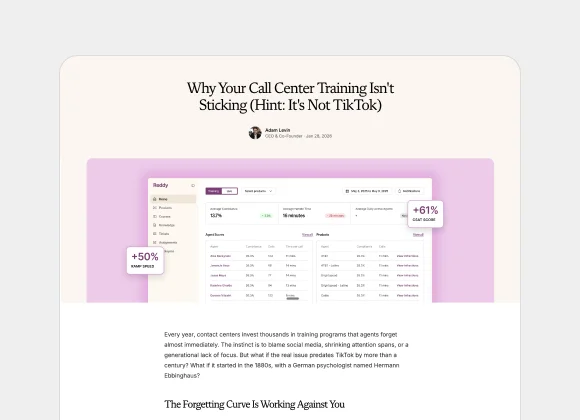
The short version: for most contact centers in 2026, Reddy is the best call center QA software. It scores 100% of interactions against a digitized version of your own quality scorecard, and the gap it finds becomes practice the agent completes inside a replica of the systems they actually work in, graded on that same scorecard, before their next shift. That same scored data rolls up through the Reporting Suite, putting contact drivers, compliance concentration, and per-agent patterns in one view, so quality stops being a number you report and becomes a case you can make. The platform suites (NICE CXone, Genesys Cloud CX, Five9) bundle quality with the telephony most buyers already run, and they are the default any challenger has to beat; AmplifAI and Cresta are the strongest alternatives to them, approaching quality from the performance-management and real-time-AI directions. The full ranking, and the criteria behind it, are below.
What is call center QA software?
Call center QA software evaluates customer interactions against a quality scorecard, scores agent performance, and turns what it finds into coaching, compliance protection, and operational intelligence. Legacy programs did this with human evaluators sampling a small share of calls. Modern platforms use AI to score 100% of interactions across voice and digital channels, with human evaluators shifting from grading everything to calibrating the AI and handling the judgment calls.
Three adjacent categories used to sit clearly outside this one, and as of 2026 two of them no longer do. Conversation analytics platforms, built to explain why customers call and what drives churn, now score interactions against scorecards. Real-time guidance platforms, built to coach the agent mid-call, now run post-call automated evaluation as well. Both are in this ranking as a result, and a buyer who rules them out on category grounds is working from an org chart that vendors have already abandoned. Simulation software remains genuinely distinct, because it prepares agents before the interaction rather than evaluating it afterward, but the strongest programs connect the two: a QA score that never changes what an agent practices or how they are coached is just a number in a dashboard.
Why QA software matters in 2026
Start with the math. If your evaluators review 2% of interactions, an agent handling 500 calls a month is being judged on 10 of them, and probably fewer. That sample is too small to distinguish a coaching problem from bad luck, too slow to catch a compliance pattern before it becomes exposure, and too thin to defend in a dispute. Moving from 2% to 100% coverage is not an incremental improvement to the same program. It is a different program: every compliance miss visible, every coaching opportunity surfaced, every agent judged on their actual body of work.
The second pressure is what AI is doing to the work itself. As AI absorbs the routine volume, human agents inherit a queue that is more complex, more emotional, and higher-stakes per interaction. The QA function inherits that shift too. Scorecards built for checkbox compliance (did the agent read the disclosure, did they use the greeting) miss the judgment and soft-skill dimensions that now decide outcomes, so scoring rigor matters more than it did when the queue was full of password resets.
The third is that quality no longer ends at scoring humans. AI agents are answering customer conversations now, and some platforms in this ranking have moved to score them alongside human agents. Whatever you buy in 2026 should have an answer for how quality gets managed as the floor becomes a mix of both.
Our methodology for evaluating QA platforms
We assess platforms the way we would if we were the buyer. Six criteria, weighted in this order.
- Coverage. Does the platform score 100% of interactions across voice and digital channels, or is it still built around sampling? Partial coverage means blind spots, and blind spots are the problem you are buying your way out of.
- Scoring rigor. Can the AI grade judgment and soft skills (empathy, de-escalation, problem-solving) against your own scorecard, or does it pattern-match keywords? And does it agree with your best human evaluators when you run them side by side? Inconsistent scoring quietly destroys trust in the program.
- What happens after the score. Does a QA finding automatically become coaching and practice, or does it stop at a dashboard? This is the criterion buyers most often skip and most often regret skipping. A score is a diagnosis; the program's value is in the treatment.
- Scorecard flexibility. Can the platform digitize the scorecard you already run, including different scorecards per line of business, and hold internal teams and BPOs to the same standard?
- Compliance and risk detection. Does it flag missing disclosures and risky language in real time, or do you find out in next month's report?
- Time to value. How long from signature to scored production traffic your team actually trusts? Weeks is competitive in 2026. Quarters is not.
A platform can be excellent on some of these and weak on others. The point of the criteria is to help you figure out which ones you actually need, not to rank the market on a single composite score. Where we call a vendor "best for X," that is the read.
What changes when you can see every call
Coverage is easy to promise and hard to make matter. The real question is what changes on the floor when scoring goes from a sliver of calls to all of them. We have run that transition with customers who let us publish the numbers, and the pattern holds at two very different scales.
ISG, in a big way. Infinity Sales Group is an 800+ agent outsourced sales operation working with top global brands. Before Reddy, its QA ran on manual sampling that reached only about 1% of calls. Coaching was retroactive, and quality had plateaued, not for lack of skill but because 99% of the floor was invisible. Reddy's Auto QA scored every interaction against a digitized version of ISG's own quality scorecard, the same standard agents practiced against in simulation. Call analysis capacity rose 99x, from that sliver to nearly every call, and call quality climbed 135% against the prior baseline. The program returned 3.5x in its first year on $1M of annualized savings, in part because the QA team no longer spent its hours scrubbing calls by hand.
The automation of QA analysis has been a game-changer. We can now analyze nearly every call, which was impossible before. — Nick Viracacha, Director of Sales, ISG
Harte Hanks, the same pattern at scale. Harte Hanks is a global CX provider running thousands of agents across international centers. Same move, larger and more distributed operation: once scoring covered the full body of interactions instead of a sample, QA scores rose 6%. A smaller headline figure than ISG, but the direction is identical, and it held across a multi-site workforce where sampling blind spots are worse, not better.
The takeaway across both: coverage alone is not what moved the numbers. Coverage plus a place for every finding to go is. When the scorecard grading live calls is the same one agents practice against, each gap has somewhere to land, and the floor improves continuously instead of being audited occasionally.
The 10 best call center QA software platforms for 2026
Ten platforms, ordered as explained above rather than by composite score. Your own shortlist may land differently; each entry closes with the buyer profile it fits best.
| Platform | Best for | Core strength |
|---|---|---|
| Reddy | Contact centers that want QA to change floor behavior, not just report on it | 100% AI scoring on your own scorecard + automatic QA-to-simulation coaching loop |
| NICE CXone, Genesys Cloud CX, Five9 | Teams whose quality needs are met by the module bundled with their telephony | Autoscoring and compliance recording native to the platform you already run |
| AmplifAI | Performance-management-led quality programs | Auto QA on 100% of interactions wired into coaching and recognition |
| Cresta | Operations running human and AI agents on shared infrastructure | Automated scoring against custom rubrics inside a real-time AI platform |
| Level AI | Teams that want the deepest dedicated AI-QA engine | Semantic auto-scoring on custom scorecards |
| Balto | Voice operations that want scoring and live guidance on one system | 100% automated scoring plus real-time guidance and AI coaching packets |
| Observe.AI | Large, voice-heavy enterprises | Conversation intelligence suite with auto QA and real-time assist |
| CallMiner | Regulated industries that need analytics depth behind the score | Conversation analytics with compliance and root-cause analysis |
| MaestroQA (now Rippit) | Mature human-evaluation programs | Grading workflows, calibration, and coaching rigor |
| Verint | Regulated enterprises that need autoscoring on an auditable recording layer | Automated quality management with deep compliance and recording heritage |
1. Reddy
Reddy is call center QA software that scores 100% of your interactions against your own quality scorecard, and it is the top pick in this guide because of what it does with the result. Several platforms here now route a finding into a coaching action, and that is real progress over a dashboard. The distinction is where the loop lands. When Auto QA finds a gap in a live interaction, Reddy assigns the matching simulation: the agent works that exact skill inside a replica of the systems they navigate on the floor, graded on the same scorecard that flagged it, before their next shift.
Reddy is an AI coaching platform built for the full CX agent lifecycle. Auto QA analyzes every second of every interaction, voice and digital, and scores it against a digitized version of your own quality scorecard. Agents practice against that same scorecard in system-replica simulations before they go live, Reddy Live Assist guides them during the interaction, and the Reporting Suite ties quality, coaching, and customer intelligence into one view. For a QA buyer, the pitch is simple: one comprehensive set of metrics follows each agent from practice into live performance and coaching, and everything the scoring finds feeds back into sharper practice.
Key strengths
- 100% coverage with every second analyzed. Reddy scores all of your interactions, so sampling errors and blind spots go away. The interaction library is searchable in plain language ("show me calls where agents missed the upsell"), which turns QA data into an operational tool rather than an archive.
- Your scorecard, graded with human-level precision. Reddy digitizes your specific scorecard and grades logic and soft skills, the judgment dimensions that keyword-based systems miss. The same criteria score internal teams and BPOs, so outsourced quality is finally measured on the standard you actually hold.
- Findings become practice, not just notification. QA gaps automatically trigger simulation assignments in replicas of your live systems, and production findings feed back into the practice library. Real-time flagging catches missing disclosures and risky language while there is still time to act. In published deployments, this moved ISG from roughly 1% manual coverage to nearly 100% with a 135% lift in call quality.
Where it falls short
- It is not a standalone grading tool. Digitizing your existing manual evaluation process and changing nothing else is a narrower job than Reddy is built for, and there are lighter point tools further down this list that cover it. Reddy's power shows up when a score drives practice and coaching, so a team that wants grading alone would leave most of the platform switched off.
Best for: Contact centers that want QA coverage to change floor behavior rather than describe it. Especially strong for operations holding BPOs to an internal standard, and for teams that want quality, practice, and coaching on one scorecard instead of three disconnected tools.
2. The CCaaS platforms: NICE CXone, Genesys Cloud CX, and Five9
This entry is not second because these platforms score best. It is second because it is where most buyers start, and because the honest first question in this category is not which QA tool to buy but whether the module that ships with your telephony means you never have to.
All three autoscore rather than sample. NICE CXone pairs quality management with the compliance-recording and interaction-analytics heritage the company built its business on. Genesys Cloud CX runs AI Scoring inside its evaluation forms and has extended automated agent scoring across evaluation programs, with a March 2026 language-model update aimed at scoring consistency. Five9 Automated Quality Management evaluates up to 100% of interactions across voice, screen recording, and digital transcripts, adding calibration tools, KPI dashboards, and gamification, with quality folded into its wider Genius AI suite.
Key strengths
- Nothing to integrate. Quality sits beside recording, routing, and workforce management on the platform your agents already sign into, which removes the implementation project and the second vendor relationship at once.
- Automated scoring. Genesys and Five9 both shipped substantive scoring updates inside the last year, so "the included tool cannot really grade a call" is no longer a safe assumption.
- Compliance, recording, and audit depth that regulated programs are held to, at a deployment scale no dedicated tool can match.
- Adjacent capability comes with it. Workforce management, routing, and analytics arrive from the same vendor, which for some operations matters more than scoring depth does.
Where it falls short
- Licensed is not the same as running. The most common thing we hear from teams on these platforms is that the quality module is owned and idle, with evaluators still listening to calls and scoring them on a sheet. Before you evaluate anything else, find out why the one you already pay for never got switched on. The answer is usually the real requirement.
- Capability sits behind the next tier. On CXone, teams report that call transcription arrives only if you also buy interaction analytics, and that working through those analytics costs about as much effort as monitoring calls by hand. Price the configuration you actually need, not the module name.
- Scores without outputs. A recurring complaint is anecdotal signal rather than a report or dashboard anyone can act on. Ask to see the artifact a supervisor opens on Monday morning, not the scoring demo.
- The screen is invisible to it. On a lot of scorecards, close to a third of the criteria are about what the agent did in the tools rather than what they said: which system they opened, whether they documented correctly, how long they hunted for the answer. Voice-first quality management cannot see any of it, so that portion of your scorecard stays manual no matter how good the speech scoring gets.
Best for: Contact centers already on one of these platforms whose quality needs are compliance-led rather than coaching-led. Worth saying plainly that this is not an either-or decision: plenty of operations keep the platform for telephony and recording and add a dedicated quality layer on top of it, rather than replacing anything.
3. AmplifAI
AmplifAI comes at quality from the performance-management side. Its Auto QA scores 100% of interactions with AI compliance monitoring and calibration workflows, then wires the results into coaching, recognition, and role-based dashboards, with data unified across CCaaS, CRM, and workforce management systems. When scoring flags an auto-fail or a trending gap, the platform triggers a coaching action with the relevant context attached.
Key strengths
- Auto QA across channels with calibration workflows preserved, so the AI can be held to your evaluators' standard rather than replacing it unexamined.
- Auto-fail and trend detection that routes straight into a coaching action, one of the tighter QA-to-coaching handoffs in this ranking.
- Recognition and gamification alongside quality, which keeps the program visible to agents rather than experienced as enforcement.
- Data unified across the operational stack, so quality scores sit next to the performance metrics leaders already manage to.
Where it falls short
- The handoff delivers context, not repetition. An agent receives a coaching action with the call attached, but there is no environment where they work the missed skill against a scorecard before the next shift.
Best for: Contact centers running a performance-management motion that want scoring, coaching, and recognition on the same data rather than a standalone evaluation tool.
4. Cresta
Cresta is a real-time AI platform with quality management inside it. Cresta Quality Management scores every interaction against custom rubrics rather than sampling, and it sits alongside Agent Assist, Conversation Intelligence, Cresta Coach, and AI agents that handle conversations directly, across voice, chat, and email. Its positioning is explicitly hybrid: human and AI agents managed on one system rather than two.
Key strengths
- Automated scoring against your own rubrics on every conversation, with the real-time layer and the post-call layer reading the same data.
- A credible answer for AI-agent quality, since Cresta runs AI agents itself and manages them beside human agents rather than treating bot conversations as a reporting afterthought.
- Adjacent breadth: real-time guidance, analytics, manager coaching tools, and a natural-language layer for leadership questions.
Where it falls short
- Cresta Coach is manager-facing. It structures the conversation between a supervisor and an agent; it does not give the agent anywhere to practice the skill that was flagged.
Best for: Operations already running or planning AI agents alongside humans, that want scoring, live guidance, and coaching on shared infrastructure.
5. Level AI
Level AI is the strongest dedicated AI-QA engine on this list. Founded in 2019, it was built AI-first: its scoring reads meaning rather than matching keywords, which shows up most on the judgment-heavy scorecard items (did the agent actually resolve the issue, did they show empathy) where older systems fall down. In 2026 it launched AI Workers, specialized AI agents for QA-adjacent roles, extending the automation beyond scoring.
Key strengths
- Semantic auto-scoring on fully custom scorecards, strong enough to grade nuanced items rather than checkbox compliance alone.
- QA-first product depth: screen recording, evaluator workflows, agent assist, and analytics built around the quality function rather than bolted onto a suite.
- Rapid product velocity, with the 2026 AI Workers launch pushing automation into insight generation and workflow tasks.
Where it falls short
- Coaching stops at insights and assignments. Like most of the category, Level AI can route a finding to a coaching session but has no practice environment, so skill gaps are identified more effectively than they are closed.
Best for: Teams whose top criterion is scoring rigor: they want the most accurate, most customizable AI evaluation of every conversation, and have their own answer for coaching and practice.
6. Balto
Balto scores 100% of conversations automatically and hands the result back to the agent inside their own app, with an AI explanation of why the call scored the way it did. Scorecards are configured in natural language, and the same platform runs real-time agent guidance during the call alongside compliance monitoring, call summarization, and screen recording.
Key strengths
- Automated scoring on every call, with scorecards a QA lead can write and revise without a professional-services engagement.
- Findings feed forward into live guidance and AI-generated coaching packets per agent, so a scored gap surfaces on the next call rather than in the next review cycle.
- Scores and their explanations go to the agent directly, which does more for program credibility than most quality tools attempt.
- Genuine third-party validation in a category where independent analyst coverage is thin.
Where it falls short
- Voice is the center of the product, and digital channels arrive through a separate omnichannel line rather than the same quality surface. Teams with heavy chat and email volume should scope that carefully.
- The loop closes into prompts and coaching material. It tells the agent what to do differently in the moment and gives the supervisor something to work from, but there is still no graded environment where the agent rehearses the skill before going live.
Best for: Voice-heavy contact centers that want automated scoring and real-time guidance from one platform, with quality results visible to agents.
7. Observe.AI
Observe.AI is one of the most established names in contact center AI. Founded in 2017, it built its reputation on voice: high-accuracy transcription, conversation intelligence, auto QA, and real-time agent assist, with AI voice agents added to the portfolio more recently.
Key strengths
- Auto QA that evaluates 100% of interactions, replacing the 1-2% manual sampling model, with strong compliance monitoring for regulated environments.
- Mature real-time agent assist and post-interaction analytics on the same platform, so QA findings sit alongside live guidance and business insight.
- Deep voice heritage. Transcription and call-analysis quality remain the foundation the rest of the suite is built on.
Where it falls short
- The loop ends at insight. Observe.AI can tell you which agents need coaching and on what, but there is no practice environment attached: flagged agents get told, not trained. Pairing it with a simulation platform is common.
Best for: Large, voice-heavy enterprises that want conversation intelligence, auto QA, and real-time assist from one vendor and have the coaching motion to act on what it finds.
8. CallMiner
CallMiner has been doing conversation analytics since 2002, and quality scoring is one output of an analytics engine rather than the product's original purpose. That heritage is the reason to consider it. Where most platforms tell you an agent scored poorly, CallMiner is built to explain what is happening across thousands of conversations and why, with the compliance and risk depth regulated industries buy for.
Key strengths
- Analytics depth behind the score, including root-cause analysis across full interaction volume rather than agent-level scoring alone.
- Compliance and risk detection built for regulated environments, with a long track record in financial services, healthcare, and collections.
- Proven at enterprise scale, with an open integration layer (APIs, connectors, and its Open Voice Transcription Standard) for pulling audio and transcripts from existing systems.
Where it falls short
- The evaluator experience is thinner than in tools built around the quality function. Programs that run on calibration sessions, grader-agreement tracking, and formal dispute handling will find less of that workflow here.
- Insight is the deliverable. CallMiner surfaces what is going wrong at a level of detail most platforms cannot match, and then the work of turning that into changed agent behavior sits entirely with your team.
Best for: Regulated, analytics-driven operations that need to understand patterns across every conversation, with a coaching motion of their own already in place.
9. MaestroQA (now Rippit)
MaestroQA spent nearly a decade as the workflow standard for human-led QA: calibration sessions, grader-agreement tracking, dispute handling, coaching workflows, and screen capture, trusted by well-known CX brands. On February 24, 2026 the company rebranded as Rippit and repositioned as an AI conversation analytics platform spanning voice of customer, revenue operations, customer success, and support, with its founder stating publicly that the company was "saying goodbye to being a QA company." Most of the market, including every competing ranking we reviewed while building this one, still calls it MaestroQA.
Key strengths
- Mature human-grading workflows.
- Strong coaching and accountability tooling: evaluations connect to coaching sessions, goals, and follow-up, with the audit trail enterprise programs need.
- Screen capture alongside conversation review, useful where process adherence matters as much as the conversation.
Where it falls short
- Automated scoring arrived later here than at the AI-native platforms above, and the product's strength remains the workflow around human evaluation rather than automated coverage.
Best for: Teams with established, calibrated human-evaluation programs that want workflow rigor, and are comfortable betting on the vendor's post-rebrand direction.
10. Verint
Verint has been in quality management longer than almost anyone in this ranking, and Verint Automated Quality Management is the modern expression of that: AI autoscoring of up to 100% of voice and text interactions, against the 1 to 3% a manual program typically reaches, sitting on top of the recording and compliance layer the company built its business on. Unlike the platforms above, Verint does not sell you the phone system. It sells quality management as the product, on top of whatever telephony you run, which is why it surfaces in regulated operations where an auditable record carries as much weight as the score attached to it.
Key strengths
- Autoscoring across voice and digital channels on one platform, which brings the consistency and objectivity argument that only comes from grading everything instead of a sample.
- Agent KPI trending with coaching and learning events marked on the same timeline, so a supervisor can see whether performance actually moved after the intervention that was supposed to move it.
- Alerting when an agent's performance drops below an acceptable range, which shortens the distance between a problem appearing and someone acting on it.
- Compliance and recording depth built for regulated industries, backed by one of the longest deployment track records in the category.
Where it falls short
- The coverage claim is "up to" 100%, and how close you get depends on channel mix and configuration. Pin down what full coverage means for your specific voice-to-digital split before you sign.
- The response to a finding is an alert and a coaching marker. Someone still has to decide what the agent does about it, and the agent has nowhere to rehearse the skill before the next interaction.
Best for: Regulated enterprises that want autoscoring on top of a recording and compliance layer they can defend in an audit, and that are already weighing Verint against NICE for the broader workforce platform.
Our take: what most teams get wrong about QA software
The most common failure mode in call center QA is a program that produces scores instead of outcomes. Teams spend months selecting a platform on scoring accuracy, deploy it, watch coverage jump from 2% to 100%, and then discover that the floor performs exactly as it did before, because nothing connects the finding to the fix. Fifty times more data about the same unaddressed problems is still the same unaddressed problems. Most of the platforms above now advertise some version of a closed loop, so ask the sharper question and do not accept a dashboard as the answer: when your platform finds a gap, what does the agent actually do differently, and who has to set that up by hand?
The second mistake is skipping calibration. Run any AI scoring engine side by side with your best human evaluators on the same interactions for two weeks before you trust it, and test it on your hardest scorecard items (judgment, empathy, de-escalation), not just the checkbox compliance items every engine gets right. Agreement on the easy 80% is table stakes. Agreement on the hard 20% is what tells you whether the platform can actually grade your definition of quality, and it is where the platforms on this list separate. Whichever engine you calibrate, the criteria have to be observable in the first place: our call center QA checklist walks the six categories and the yes-or-no test every item has to pass.
Frequently Asked Questions
See what 100% coverage would find on your floor
Score every second of every interaction against your own scorecard with Auto QA, and let what it finds trigger the simulation that fixes it. ISG moved from sampling roughly 1% of calls to scoring nearly all of them and lifted call quality 135%; the same loop is available for your operation. If that is the shape of the problem you are trying to solve, we would like to show you the platform. We also run Reddy Live Assist and the Reporting Suite for teams that want guidance during the interaction and intelligence after it.