
In a demo, the AI customer sounds perfect. It hesitates, it gets frustrated, it talks over the agent the way a real caller does. Everyone in the room nods. It feels like proof.
Then the agent takes their first live call and freezes. Not because they couldn't hold the conversation. They rehearsed that part. They freeze because they've never pulled up the account, read the right field, and chosen the right path while a person waited on the line. Even when the AI customer is great, the practice left the systems for the agent to learn on a real customer.
The realism that shortens time-to-proficiency isn't only how real the AI customer sounds. It's whether the agent practices inside a working replica of the exact systems, screens, and decisions they'll face on a live call. A convincing voice is one piece of realism. System and process fidelity is the piece that transfers to the floor.
What makes a call simulation realistic?
A call simulation is realistic when it reproduces all three parts of a live interaction at the same time: the customer conversation, the systems the agent operates while they talk, and the process branches the scenario forces them to choose between. Most tools reproduce the first and stop. That's why an agent can sound fluent in practice and still come apart the moment the conversation and the software have to happen in the same thirty seconds.
Realism is what the agent does, not just what they hear
Day 1 is never just a conversation. It's the conversation plus everything around it: finding the record, moving between tabs, applying the policy, picking the branch the script never mentioned. All of it happens at once, with a customer waiting. A simulation that lives in a chat window drills one of those skills and ships the rest to the live floor, where every mistake has a customer attached.
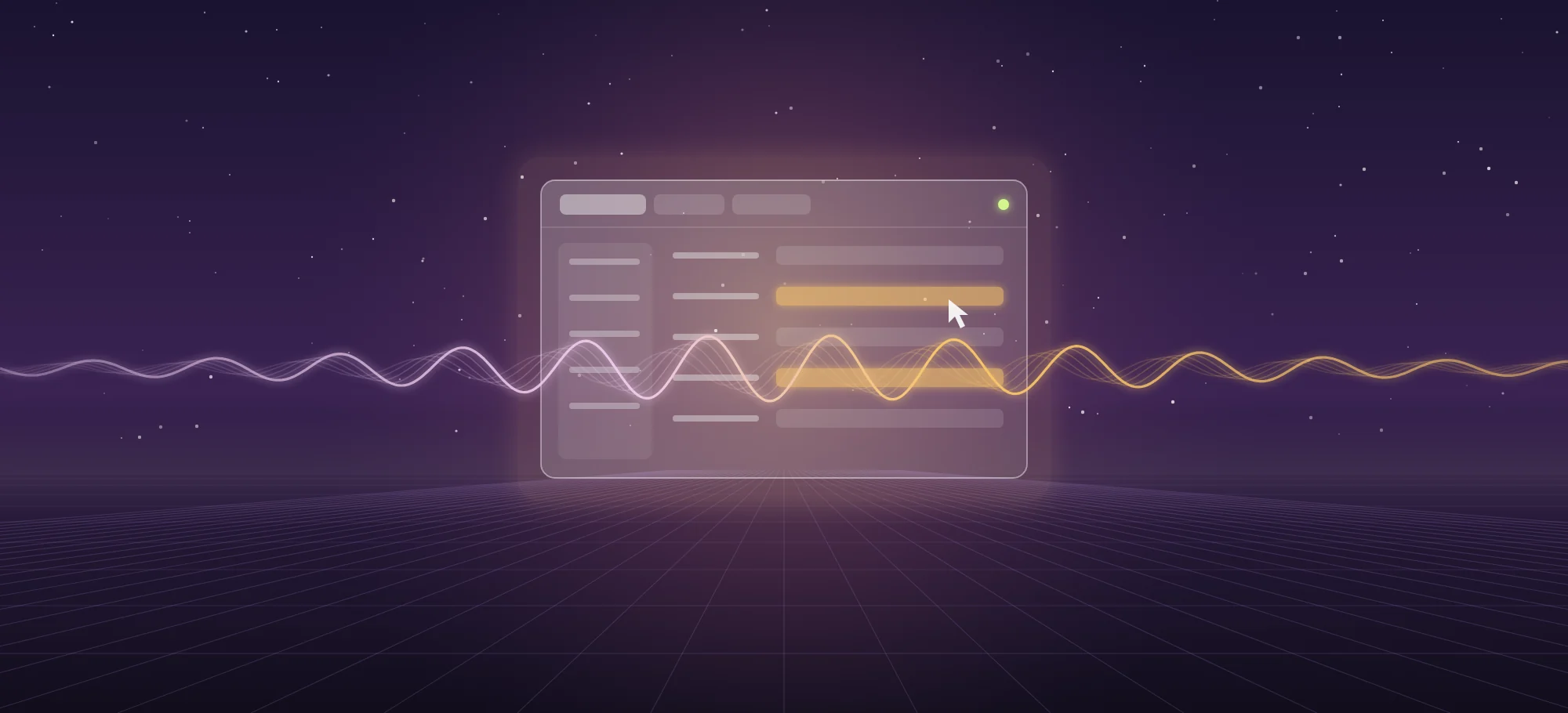
Realistic practice rebuilds the environment itself. A screenshot of the CRM doesn't clear the bar, and neither does a perfect voice in front of a static slide. The agent clicks, searches, and commits to decisions inside a working replica of the tools they actually use. The talking and the doing run together, the way they do on a live call, because that's the only way the muscle memory survives contact with a real customer.
The decision tree is the other test. A real interaction forks: one path for product A, another for product B, the escalation route, the exception nobody wrote down. A realistic simulation forces the fork and grades which way the agent went. A scripted one lets them coast the single path they rehearsed and calls it practice. The tell is simple. If every run of a scenario ends the same way, it's a script with a voice on top, not a test of judgment. And judgment is the thing you're actually trying to build.
How we build realism into Reddy
Everything above is how we think about practice, and it's the backbone of what we build. Reddy is an AI platform that trains, evaluates, and coaches contact center agents inside the real systems they use on every call. Our simulations reproduce all three parts of a live interaction at once: an AI customer drawn from your real calls, a working replica of your CRM, ticketing, and workflows, and the branches your agents actually face. A wrong click teaches instead of costing a customer.
Realism also can't depend on a months-long build, or almost nobody gets it. Reddy's AI agents build the environment from your existing calls, scripts, and documentation, and when a product or script changes, you tell Reddy in plain English and the update is live the same day.
What it looks like when the practice matches the job
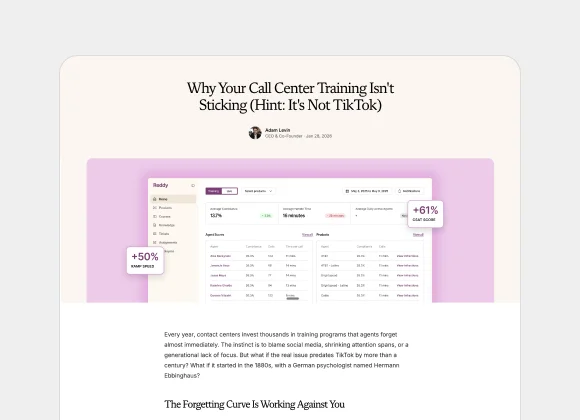
When practice mirrors live conditions, the skills transfer, and the transfer shows up in the numbers leaders already watch. Morgan & Morgan, one of the country's largest personal injury firms, needed intake specialists confident in Salesforce from Day 1. Reddy replicated Morgan's entire Salesforce environment, so agents practiced navigating the CRM and handling an emotionally charged call at the same time, rather than one and then the other. Ramp time was cut in half, from 12 weeks to 6. The training content had always been good. What changed was rehearsing the system and the conversation together, before the first real call instead of during it.
Realism doesn't stop at practice
A realistic simulation gets an agent ready for Day 1. Keeping them sharp after that takes a loop. Auto QA scores every call, chat, and email against your own scorecard, not the small sample a manual team has time to hear. When it finds a miss, that miss becomes an assigned practice session on that exact situation, graded on the same scorecard that grades live calls. Nobody has to turn the finding into an assignment or find an hour to schedule it.
The results roll up in reporting, so leaders can watch proficiency move across teams instead of hoping it did.
How to pressure-test realism before you buy
Every vendor will tell you their simulations are realistic, and every demo will sound good. The only way to find out what kind of realism you're buying is to ask about the parts a demo doesn't show. Take these four questions into any vendor conversation:
- Does the agent operate the real systems during practice, or only talk?
- Can it reproduce your specific process branches, or just a generic flow?
- Does it score navigation and decisions, or only what was said?
- How close is the practice environment to what's actually live on the floor?
Start with the first one. If the honest answer is "they talk," the other three are premature, because you're evaluating a conversation tool, not a practice environment, no matter how real the voice is. For a side-by-side of how ten platforms answer these, see our guide to the best call center simulation software.
Frequently Asked Questions
A convincing voice is one piece of a realistic simulation. System and process fidelity is what moves proficiency, because it's the only kind of practice that reproduces the job rather than a slice of it. If you want to see what that looks like with your own systems, see Reddy in action.