

Most call center root cause analysis ends with a slide. A team pulls a sample of calls, tags the reasons, ranks them, presents the top five in a quarterly readout, and the operation moves on. Next quarter, the same five reasons are back.
The finding was never the product. Root cause analysis pays off only when the cause lands on an owner, with a fix, and a number that shows whether the fix worked. Everything short of that is documentation. This guide covers what root cause analysis is in a contact center, why it stalls, how to run it step by step, and the loop that most programs never close.
What is root cause analysis in a call center?
Root cause analysis is the practice of tracing a recurring problem past its symptoms to the condition that produces it, then removing that condition. In a call center it runs at two levels. The first is why customers contact you at all: the contact drivers, like a confusing invoice, a delayed shipment, or a password flow that fails on mobile. The second is why interactions go wrong once they start: the quality issues, like a skipped verification step, a wrong answer, or a promise the process cannot keep.
Most guides treat these as one analysis. They are two, with different owners. Contact-driver causes usually end in a product or process fix outside the call center. Quality causes usually end in coaching inside it. Keeping the two separate is half of doing this well.
Why root cause analysis stalls
The sample problem
An analysis built on two percent of calls ranks anecdotes. A cause that appears twice in fifty reviewed calls might be your largest driver or might be noise, and the sample cannot tell you which. Teams then argue about the ranking instead of acting on it, which is a rational response to thin evidence.
The stated-reason problem
At the end of every call, the agent picks a reason from a dropdown, and those tags are what your contact-reason report is built from. They record the complaint the customer opened with, not the condition that produced it. The customer describes a connection problem, the agent runs the connection flow, and the real cause is an account setting that flow never touches. Rank your causes off those tags and the top of the list is partly a record of what the customer and the agent guessed was wrong.
The finish-line problem
The readout gets treated as the deliverable. Findings are hand-compiled into a deck, the deck is presented, and no cause leaves the room attached to an owner or a metric. The operation then spends the next quarter answering the same calls the untouched cause keeps generating.
How to do a root cause analysis in a call center
1. Define the problem as a measurable sentence. "Repeat calls are up" is not workable. "One in five billing contacts calls back within a week" is: it names the driver, the behavior, and the window, and it gives you the number the fix has to move.
2. Pull every interaction that matches, not a sample. The ranking of causes is only as trustworthy as the coverage behind it. If your tooling forces a sample, treat the output as a hypothesis to verify, not a conclusion to act on. Platforms that score every interaction automatically take the constraint off the table.
3. Group by what was actually wrong, not by how the call was tagged. This means reading or listening to the interactions, or having software that already has. Group calls by the condition that generated them, and expect the groups to disagree with your contact-reason report.
4. Ask why until you reach something you can change. This is the 5 Whys, and it is simpler in practice than in diagrams. A worked example:
- Why are customers calling back? The credit they were promised is not showing on their account.
- Why is it not showing? Credits post at the next billing cycle, up to four weeks out.
- Why don't customers know that? Agents say "the credit has been applied" and end the call.
- Why do agents say that? Their workflow marks the credit complete the moment it is entered, and nothing prompts a timeline.
- Root cause: the process makes a promise the billing cycle cannot keep.
The fix is not "coach agents to be clearer." It is one expectation-setting line added to the call flow and the confirmation message. You stop asking why when the answer is a condition someone in the building can change.
5. Split behavior causes from process causes. They route to different owners. A broken flow goes to the process or product owner; a skipped probing question goes to agent coaching. Mislabeling one as the other is why "more training" so often fails: it assigns a process defect to the agents who are stuck operating inside it.
6. Give the fix an owner and a number, then watch the curve. The analysis is finished when the driver's volume bends, not when the deck is presented. If the number does not move in the window you set, the cause you found was not the root, and the analysis reopens.
How to reduce repeat calls in a call center
Repeat contacts are the sharpest root cause signal you have, because every one is a first call that failed at something specific.
- Measure reconnects per driver, not overall. A single repeat-call rate hides which promise is being broken; a per-driver rate points at it.
- Listen to second calls. The second call states, in the customer's own words, what the first call failed to do. It is the highest-yield analysis data in the operation.
- Fix expectation gaps first. A large share of repeats are a customer checking on something nobody gave them a date for. Those disappear with one sentence in the right place.
- Coach the diagnosis behavior. The rest of repeats trace to solving the stated problem instead of the actual one, and that is visible on the first recording.
- Verify by the curve. A repeat-call fix that worked shows up as a bend in that driver's reconnect rate within weeks.
How to reduce call volume in a call center
Volume reduction is driver elimination, worked from the same analysis:
- Rank drivers by volume multiplied by preventability. Some contacts you want more of. Rank what customers are actually calling about by both size and preventability, and ignore the rest.
- Remove the cause, not the call. Fixing the confusing invoice beats deflecting the calls it generates; a deflected call about a defect is still a failure the customer experienced, just a cheaper one.
- Convert status checks into notifications. "Where is my refund" and its relatives exist because the customer had no other way to know. Proactive updates retire the whole category.
- Re-rank monthly. Drivers shift with product changes, promotions, and billing cycles, and last quarter's ranking quietly goes stale.
Root cause as a query, not a project
The reason root cause analysis became a quarterly ritual is that the inputs were expensive. Pulling calls, listening to them, tagging them, and compiling the findings takes weeks of someone's time, so it happened a few times a year, on a sample, and aged badly.
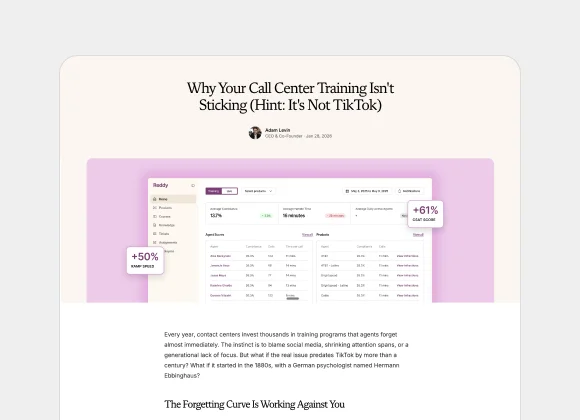
That constraint is gone when scoring and categorization happen automatically on every interaction, which is how Reddy is built. "Which drivers grew last week" and "what do the calls behind this dip have in common" stop being projects and become questions you ask on a Tuesday. And the loop closes on the floor: behavior causes route into coaching, and agents can rehearse the corrected behavior in simulation before the next live call instead of after the next miss.
Run that loop weekly and root cause analysis stops being a ritual that documents problems. It becomes the mechanism that retires them.
Frequently Asked Questions
Ask the question the deck can't answer
If finding a root cause takes a quarter, the causes will always outrun the fixes. Reddy scores and categorizes every interaction as it happens, so "why does this keep happening" is a query, and the fix has a curve to prove itself against.