

You know how the Tuesday session goes. You pull an agent off the floor, listen to two calls together, name the one thing that needs to change, and you both leave agreeing on it. Then Friday's calls sound like Monday's. The scorecard holds its pattern, the same behavior shows up in the same spot, and the next escalation comes back with a familiar name on it. None of it looks like neglect. Your supervisors are squeezing sessions in between shift coverage, your steady two-year agents haven't had a real coaching hour since nesting, and the ones who get attention are whoever is on a plan or caused the last complaint. Everybody did the work the program asked for. It just didn't take.
The published diagnosis is always operational: supervisors have no time, follow-through slips, quality varies from coach to coach, nobody can prove anything changed. Every item on that list is real, and every item is a symptom. You can fix all of them and coaching can still underdeliver. The industry has defined coaching as a conversation, and a conversation moves information. Behavior moves through rehearsal, and in most contact centers there is nowhere to rehearse.
Why does call center coaching fail?
Call center coaching fails in the gap between the session and the next call. The agent hears exactly what to change, walks back to the queue, and the first attempt at that new behavior happens live, with a customer on the line and the clock running. Under that pressure, falling back on the habit that already works is the rational move, and the coached behavior is gone by the end of the shift. Supervisor time, coach skill, and follow-through decide who gets told and how clearly they hear it. None of them decide what the agent does on that next call.
We've been fixing the wrong part
Nearly all of the advice aimed at this points at the meeting: a tighter cadence, a better template, open questions instead of score readings, documented commitments, a follow-up next week. All of it is reasonable, most contact centers have tried several, and plenty of supervisors run a genuinely good session. The report back is still the same. We coach, and the numbers don't move.
That's not a skill problem and it's not an effort problem. It's a misdiagnosis. Supervisors are doing everything the program asks of them, usually while covering the floor at the same time. What none of them have is a place for the agent to run the behavior before it meets a customer, a record of whether that happened, or a way to grade it on the scorecard that already grades live calls. A better conversation produces none of the three.
Feedback is information. Performance is behavior.
Every job that gets judged on live performance keeps practice separate from the performance itself. Musicians rehearse the piece before the audience is in the room. Trial lawyers argue the case in a moot court before they argue it to a jury. Surgeons run the procedure in a lab before they run it on a person. The rep comes first, and when it goes badly, it costs nothing.
Contact centers run it the other way around. An agent's entire working life is game time. Every call is live: listening, moving through three or four systems, de-escalating, writing notes, all at once, with a customer waiting on every pause. A coaching session gives that agent an accurate description of how to do it better. A description is not a rep.
Supervisors see how this ends every week. The behavior coached on Tuesday shows up on Wednesday, thins out by Thursday, and is gone by Friday. That distance between knowing what to do and doing it under pressure is the knowing-doing gap, and it does not open because the agent disagreed with the feedback or because the session was run badly. Tuesday was the only time that behavior got attempted anywhere other than a live call.
You already pay for practice. You just pay for it live.
Every hour of practice in a contact center costs a senior person's hour. New hires finish classroom training and go to nesting: weeks on the floor where a tenured agent or a supervisor stops taking calls to sit beside them, because the only place to try the job is the queue and someone has to catch the mistakes as they happen. Side-by-side coaching is the same purchase later in the tenure curve. The curriculum is whatever calls happen to arrive, and the tuition is a customer's experience.
Anything that expensive gets rationed. The hours go to the bottom of the performance curve and to whoever caused the last escalation, which is the right call when the hours are scarce. It also means the broad middle, the agents who are neither struggling nor excellent, can go months without practicing anything. That is not indifference from their supervisors. When rehearsal costs a senior hour, rationing is the only way to run the floor.
So the first attempt at every coached behavior lands on a paying customer, and most of the floor never gets an attempt at all.
Why the usual fixes don't hold
Inconsistent quality. With no rehearsal step, the session is the entire product, which makes the coach's personal skill the entire product. Two agents with the same problem get different outcomes depending on which supervisor they happen to report to. That is a lottery, and it does not average out across a floor.
No follow-through. A conversation leaves nothing behind. On Friday there is nothing to check except a note field and somebody's memory, so following up costs the one resource the model already spent: supervisor attention.
No measurement. You can log that a session happened. You cannot show what it produced. Call center coaching effectiveness stays a standing debate, argued from next month's numbers, because a conversation generates no evidence of its own.
We've written the operational playbook separately, covering which techniques work, where each one stalls, and how to close the QA-to-coaching loop, in How to Coach Call Center Agents. This piece is the reason the playbook alone is not enough. Run every one of those techniques perfectly and the agent still has not practiced anything.
What effective call center coaching looks like
Effective call center coaching puts a rehearsal step between the session and the next live call. The behavior found in Tuesday's calls becomes a scenario the agent runs in a replica of the systems they actually work in, with the same screens, the same tabs, the same interruptions, before their next shift. That leaves a record, because the rehearsal either happened or it did not. And it gets graded on the scorecard that already grades live calls, so improvement is something you can show instead of something you argue about next month.
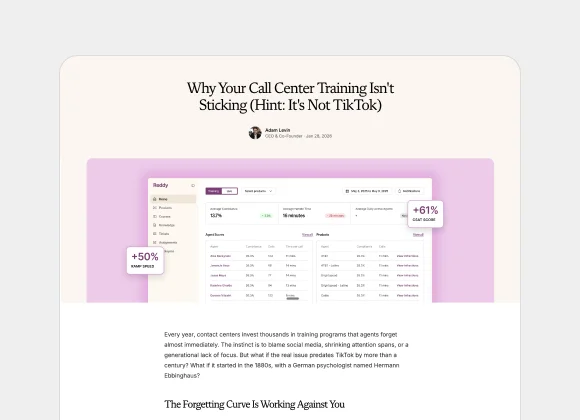
This is the model Reddy is built on. Auto QA scores every interaction and names the behavior that needs work, coaching turns that into an assigned simulation inside a replica of the agent's real systems (simulations), and the same scorecard grades the rehearsal and the next live call. The middle of the performance curve gets practice without spending a senior hour, and nobody's first attempt happens on a paying customer.
The coaching conversation still happens. It just stops carrying the entire weight of behavior change.
Frequently Asked Questions
None of this is a coaching quality problem. Contact centers have been buying practice all along, at the worst price available: nesting weeks, senior agents pulled off the queue, and customers who absorb every first attempt. That bill gets paid whether or not anyone plans for it. The only real choice is where the reps happen.