

Every year, contact centers invest thousands in training programs that agents forget almost immediately. The instinct is to blame social media, shrinking attention spans, or a generational lack of focus. But what if the real issue predates TikTok by more than a century? What if it started in the 1880s, with a German psychologist named Hermann Ebbinghaus?
The Forgetting Curve Is Working Against You
Ebbinghaus discovered something uncomfortable: without reinforcement, people forget roughly half of what they learn within the first hour. Within a few days, that number climbs to 80%. He called it the Forgetting Curve, and it applies to every type of learning, from university lectures to your most carefully designed onboarding program.
Think about your own experience. How many times do you need to read something before it stays? How many times do you need to practice a skill before it becomes second nature? Now ask yourself: does your current training program account for that reality?
Without reinforcement, agents forget up to 80% of their training within days. The problem isn't attention spans. It's that most training programs are designed to be consumed once and never revisited.
Why Some Memories Stick
Remember your first successful customer call? Or the moment a mentor helped you navigate a truly difficult conversation? Those memories endure because they carry emotional weight. They were challenging, rewarding, and real.
If you've ever watched Pixar's Ratatouille, you've seen this principle in action. A single bite of food transports a hardened food critic back to his childhood kitchen. The taste triggers a flood of memory because it's tied to genuine emotion. Traditional training modules rarely create that kind of connection. They check boxes. They don't build muscle memory.
Building Learning That Lasts
Cognitive science points to three principles that combat the Forgetting Curve:
- Spaced reinforcement: Revisiting key concepts at precisely timed intervals prevents rapid forgetting and moves knowledge from short-term to long-term memory.
- Emotional engagement: Realistic, challenging scenarios create the kind of experiences that encode deeply. Agents don't just recall the right answer. They recall how it felt to find it.
- Active practice: Reading about de-escalation is not the same as practicing it. Simulated conversations build the neural pathways that show up under pressure on real calls.
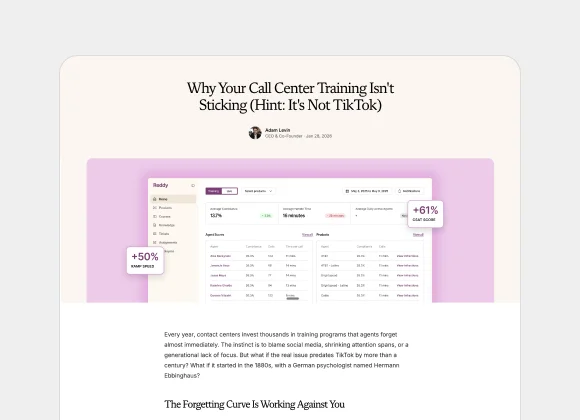
At Reddy, we've built these principles into every layer of the platform. Agents don't passively consume content. They step into realistic scenarios, practice navigating difficult conversations, and revisit critical skills right when they're about to fade. The result is agents who perform better, ramp faster, and stay longer.
Stop blaming social media for your training struggles. Start building learning experiences that respect how memory actually works. Your agents deserve it, and your customers will feel the difference.