

Watch a live call closely and you see an agent doing two jobs at once. One is the conversation: reading the customer, finding the right words, saving the interaction when it starts to slip. The other is everything behind it: searching endless tabs for the account, the policy, the order status, and the note field while the customer waits.
Most real-time agent assist is pitched on the first job. The AI listens and suggests what to say next. That help matters. But calls usually go sideways because the agent is carrying both jobs in the same moment.
On a live floor, real-time assist earns its keep by removing load from the live moment. That means the right words when the conversation shifts and the right answer without the search. And that load only lifts when the help knows how your floor actually works and there is a trained reflex behind it.
What is real-time agent assist?
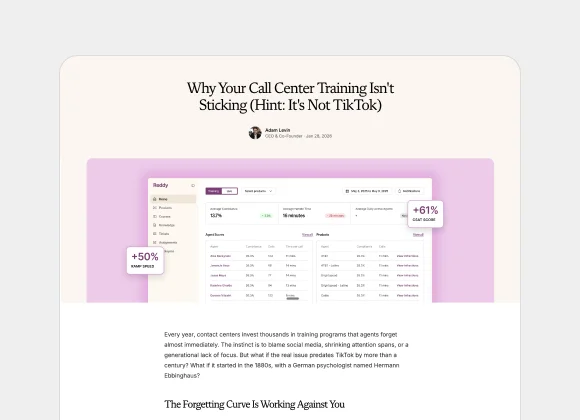
Real-time agent assist is guidance compiled during a live conversation, from live data, and surfaced at the right moment, so agents can act without stopping to search. Plenty of tools point that guidance only at what to say: a suggested line, a rebuttal, a next-best phrase. The more useful version covers the whole call. Reddy's Live Assist brings up the exact policy or rebuttal when the conversation shifts, and it guides the agent through the systems and the process the call actually runs on.
The live problem is two jobs at once.
Picture the moment a billing call goes sideways. The customer is frustrated, the agent needs the right response, and the answer is buried in a system they rarely open. Now they are holding a human conversation while hunting through tabs for the account, the policy, the order status, and the note field all at once. Either job alone is manageable. Doing both at the same time is where calls break.
So real-time assist that matters carries weight on both sides. When the conversation shifts, it brings up the exact policy or rebuttal needed to save the interaction. When the agent needs a fact, they ask and get the answer instead of hunting for it. The right record is already there, and the agent stays present with the customer instead of buried in tabs. A suggested line helps. A suggested line plus the answer, without the search, is what actually takes the load off.
Generic help gets ignored. Grounded help gets used.
Now assume the tool helps on both jobs. It can still get tuned out, and it usually does, for one main reason: the guidance is generic. A raw knowledge-base answer does not know how this business works, which exception applies to this customer, or what "handled well" looks like on your floor. Agents feel the difference between an answer pulled from a document and an answer that understands their process, and they stop trusting the first kind fast.
Two things earn that trust back. First, grounding. Guidance has to be built on your own mapped processes and the QA patterns that define a good call. That is why the live layer and the Auto QA layer belong to the same system: the signal that tells you what good looks like is the same signal that should shape what gets surfaced live. Second, restraint. A tool that nudges on every turn becomes noise, and agents learn to ignore all of it. Guidance that shows up at the moments that actually change the outcome, and stays quiet otherwise, gets read. Silence is a feature.
Live assist cannot stand on its own.
There is one more condition, and it is the easiest one to skip. Bolt real-time assist onto agents who never built the underlying reflex, and you have not given them a co-pilot. You have given them a louder crutch. They lean on the prompt for things they should already know, and the prompt slows them down.
The fix is practice before the live call. In simulations built on the same systems agents use every day, they rehearse the conversation and the clicks together until both feel routine. Then live assist has less to carry, and what it does surface sticks, because it reinforces something the agent already knows. Paired with simulations, live assist gets stronger. On its own, it's a crutch.
The call does not end at goodbye.
The load does not stop when the customer hangs up. After-call work is the same problem wearing a different hat: agents typing a summary instead of being on the next call, then hand-assembling notes into whatever field structure someone decided on two reorgs ago. It's live work that simply spilled past the live moment.
Real-time assist that follows the load all the way through captures the conversation as it happens. Summaries, action items, and dispositions are drafted before the call ends, in the structure the agent actually files into. That feeds the coaching loop: cleaner records in, better coaching out. Removing load at the end of the call is not a bonus feature. It is the same job as removing it in the middle.
Measure live assist by the load it removes.
If you are evaluating real-time assist, widen the question you walk in with. Not only "how good are its suggestions," but "how much load does this take off the agent across the whole call, is that help grounded in how we actually work, and is there a practiced reflex behind it." Score it on what the agent no longer has to carry. The demo shows you the suggestions. The floor shows you whether agents trust them.