

Every month the QA scorecard tells the same story. Disclosure compliance is soft in collections. Objection handling is thin on the retention team. Empathy language is missing on billing calls. You read it, you flag it, you send it to the floor. Next month the same categories light up red.
QA scoring diagnoses. It does not treat. A score is a record of a call that has already happened, and no record, however accurate, changes what an agent does on the next one. Most programs do try to close that gap, with a one-on-one or an action plan, but the handoff is manual, and a manual handoff dies under load. The score has to trigger the practice, not just report the need for it.
What is the difference between QA and simulation training?
QA is evaluation. It scores calls that already happened against a scorecard, so you know which interactions failed and why. Simulation training is repetition. It puts the agent back into the situation the score flagged and has them run it again, before the next live call, until the right move is automatic.
In one line: QA is diagnosis, simulation is treatment. QA tells you the disclosure gets missed on collections calls. Simulation is where the agent practices delivering that disclosure, inside a replica of the account they were working, until they stop missing it.
What QA is actually good at
Automated QA earns its place. It scores every call instead of the small sample a manual team can listen to, applies the same scorecard across all of them, and surfaces patterns a supervisor spot-checking calls would never catch: the objection that trips up the whole retention team, the compliance phrase that slips on Fridays.
That is measurement, and measurement is necessary. It is also not enough on its own. Knowing which calls failed is not the same as having agents who fail less.
Why the same failures keep showing up
The reason the scorecard repeats is structural, not a discipline problem on the floor.
A score is feedback about the past. Behavior changes in the present, through reps. When a call gets flagged for weak objection handling, the flag names the problem accurately. It does not build the reflex to handle the objection differently next time. Naming a gap and closing a gap are different jobs.
Most centers run the loop like this: score the call, email the agent or cover it in a one-on-one, and hope it lands on the next shift. The feedback gets delivered. The practice happens when a supervisor finds an hour for it, which is not the same as when the gap appears. Some months that hour exists. In a month with high volume and short staffing it does not, and the agent walks back onto the floor with the same instinct they had before. Same category, red again. The scorecard is not stuck. The loop is open.
What treatment looks like: practice in a replica of the real workflow
Treatment means the agent re-runs the exact situation the scorecard flagged, before it happens live: the same objection, the same irate opener, the same disclosure, repeated until the response is automatic.
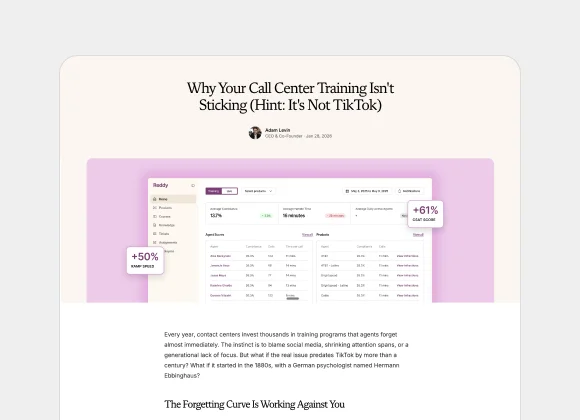
Most of the hard failures are not conversation-only. They happen while the agent is also navigating systems: pulling up the account, reading the right screen, applying the adjustment, all while keeping the customer calm. Practice that rehearses only the words leaves the hardest part untrained. That is why Reddy simulations run inside a working replica of the systems the agent actually uses, the same screens and tools they will have open on a live call, so the talk and the workflow get practiced together.
Closing the loop: QA and simulation as one system
Run alone, each half stalls. QA without practice is a monthly report on failures you keep re-reading. Practice without QA is reps aimed at nothing in particular.
Connected, it runs like this. Auto QA scores the interaction against your scorecard. The miss it finds becomes an assigned practice session on that exact situation, graded on that same scorecard, inside the replica of the systems the agent works in, before their next shift. Nobody translates the finding into an assignment. Nobody schedules it.
Most QA platforms now advertise some version of this, so the useful question in a demo is who does the work: when the platform finds a gap, what does the agent actually do differently, and who has to set that up by hand? A loop that still depends on a supervisor building the practice session is the manual handoff again with a dashboard in front of it.
When the handoff is automatic, next month's scorecard measures a different problem, because the last one got closed on the practice floor instead of getting re-flagged. The scorecard you read in January and the one you read in June finally name different problems.
Frequently Asked Questions
See the loop
Reddy runs both halves: Auto QA scores the calls, and simulation turns the misses into practice inside a replica of the real workflow, assigned automatically, before the next shift.