


A Harvard professor recently tested a simple hypothesis: what if students could replace some of their in-person class time with AI-powered tutoring? The results surprised even the researchers. Students reported higher engagement, faster mastery of concepts, and increased motivation. This wasn't about eliminating human interaction. It was about letting learners explore at their own pace, beyond the constraints of a rigid classroom structure.
Harvard's experiment offers a glimpse into the future of education. But limiting these insights to elite institutions would be a mistake. Every type of professional development stands to benefit from this shift, especially contact center agent development.
Why Traditional Training Falls Short
Compliance requirements have turned much of contact center training into an exercise in box-checking. Agents sit through modules, complete quizzes, and move on. The experience often feels more like a requirement than genuine professional growth.
Research has long established that adults learn best through experience. The 70-20-10 model, developed in 1996, found that professionals gain their skills from three sources:
- 70% from challenging, hands-on assignments
- 20% from developmental relationships with mentors and peers
- 10% from formal coursework and structured sessions
That first number is the key. Seventy percent of skill development comes from doing, not watching. Yet most training programs invert this ratio entirely, front-loading passive content and hoping agents figure out the rest on the floor.
70% of professional skill development comes from challenging, hands-on assignments. Most training programs spend 90% of their time on passive content delivery. That gap is where agent confidence goes to die.
Learning Through Exploration
Imagine an approach to agent development that feels less like an LMS checklist and more like an open-world video game. Agents navigate realistic customer interactions as freely as they'd explore a game environment. When they encounter a challenge and stumble, they don't get a red X and move to the next slide. They hit 'play again' and face a fresh scenario.
In one simulation, an agent might navigate a conversation with a frustrated subscriber threatening to cancel. In the next, they handle an emotional caller requesting an immediate refund. Each scenario is different. Each builds a new layer of muscle memory and confidence. And because the scenarios feel real, the learning encodes deeply.
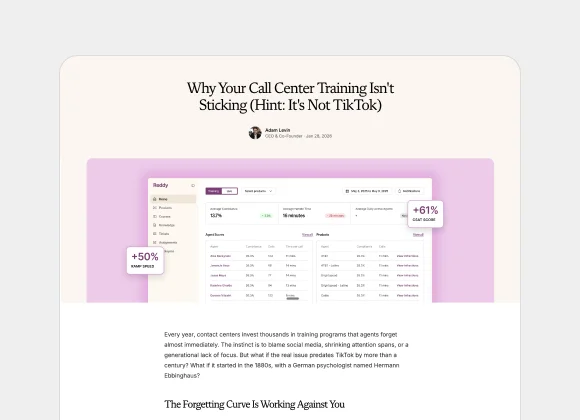
This is the approach we've built at Reddy. Our simulations are designed with guardrails that let agents experiment, make mistakes, and try again in a safe environment. The unpredictability of each scenario keeps agents engaged the way a well-designed game keeps players coming back.
Development That Doesn't Stop at Onboarding
The most important insight from Harvard's experiment isn't about replacing humans with AI. It's about extending learning beyond the boundaries of a formal session. The AI tutor worked because students could return to it whenever they needed to, at their own pace, on their own terms.
The same principle applies to agent development. Learning shouldn't stop once formal training ends. Continuous, personalized coaching woven into the flow of daily work keeps skills sharp and confidence high. Meanwhile, team leads benefit too. AI handles routine skill reinforcement, freeing coaches to focus on the meaningful, personalized development conversations that make the biggest difference.
Harvard might be leading the way in academia. But the future of effective, engaging professional development belongs to everyone. It's available today.